Seller closing costs by state: planning ranges
Educational overview. Not individualized financial, legal, or tax advice. How we source and check numbers.
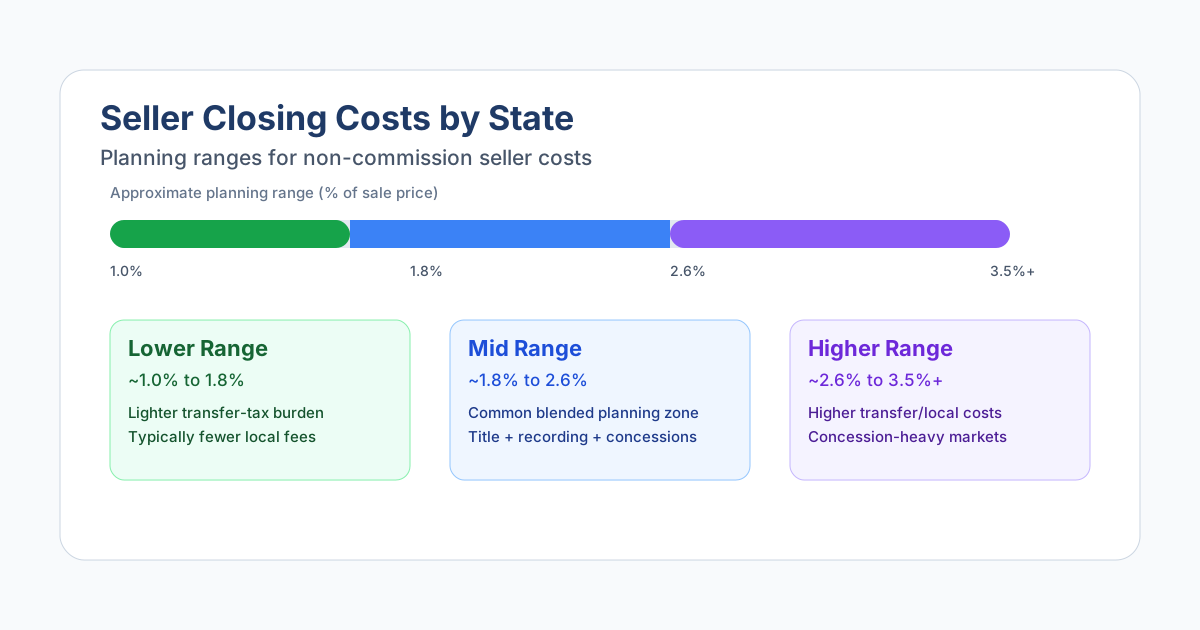
Two sellers can accept the same price and walk away with very different checks. A transfer tax in New York or New Jersey is a different bill from a sale in Indiana or Mississippi. Use the ranges and the explorer below to sketch proceeds before you list. The title company, the concessions you negotiate, and your county will still change the final number.
Many sellers start with 1 to 3 percent of sale price for non-commission closing costs, then adjust for local transfer-tax norms. Mississippi and the Dakotas sit toward 1.0 to 1.8 percent in this explorer. A lot of the country, including much of Texas and Florida once stamp-style charges are in, lives nearer 1.8 to 2.6 percent. New York, New Jersey, California, and Hawaii sit toward 2.6 to 3.5 percent and up. If buyers in your neighborhood also expect a closing-cost credit, add that on top. It is not inside these percentages. Apply a conservative band in the seller net sheet before you treat any midpoint as a quote.
What is inside the percentage, and what is not
The ranges above are not one fee, they are five or six stacked on top of each other, and knowing which is which tells you where your own state will land.
Transfer tax is the line that creates almost all the variation between states. It is a tax on the act of transferring title, usually charged as a percentage of sale price or per thousand dollars of value. Some states charge nothing at all. Others layer a state rate, a county rate, and a city rate on the same sale, which is how a New York City or Chicago transaction ends up at the top of the range. This is also why checking your county matters more than checking your state.
Title insurance and settlement fees come next, and the local custom here is the part that catches people relocating from another state. In much of the country the buyer pays for their own owner's title policy. In a number of states, particularly across parts of the South and West, the seller customarily pays it, which can add half a percent or more to your side of the ledger. Nothing about this is a legal requirement. It is negotiable custom, and your title company will tell you what is normal where you are.
Prorated property tax is a settlement adjustment rather than a fee, and it can go either direction. You owe tax for the portion of the year you owned the home. Where your state bills in arrears, you will owe a credit to the buyer at closing. Where it bills in advance, the buyer reimburses you. In a high-tax county this line can swing several thousand dollars, and it is the item most commonly missing from a seller's own estimate.
Attorney fees apply in the states that require a lawyer at closing, including much of the Northeast and several in the South. Typically this is a flat fee in the low four figures. In the rest of the country, a closing attorney is optional and most sales do not use one.
Recording and miscellaneous charges round it out: recording the deed and the release of your mortgage, wire fees, courier charges, and any HOA transfer or document fee. Individually small, collectively a few hundred dollars.
Commission, credits, and the work you do before you list
Read the rule of thumb carefully: 1 to 3 percent covers non-commission closing costs. Commission is separate, it is usually larger than everything above combined, and at 5 to 6 percent it is the single biggest deduction on your net sheet. Treating the closing-cost percentage as your total cost to sell will leave you off by roughly a factor of three.
Buyer credits are also outside these ranges. In a market where buyers have options, a 1 to 3 percent closing-cost credit is a common ask, and it comes out of your proceeds on top of the costs above. Repair credits negotiated after inspection are another line that does not exist when you list and often does by the time you close.
Finally, none of this includes what you spend before the house goes on the market. Pre-listing paint, cleaning, landscaping, staging, and photography are real money, and they are not part of any closing-cost percentage. Budget them separately so you are not surprised twice.
Pick a conservative estimate for your market, run high and low scenarios in the net sheet before listing, then refine once you have expected concessions and quote-level fees. Ask locally about county or city transfer tax, typical concession levels on your street, and who customarily pays owner's title. After that, compare full offer quality in the seller offer comparison tool.
Filter by region, choose your state, and estimate seller closing-cost dollars from your expected sale price.
Planning range
--
Estimated midpoint
--
Estimated dollar cost
--
State vs national planning range
Top planning-cost states in current filter
Ranges are planning estimates, not quote-level closing statements.
Use the explorer as a range, then replace it with a quote
The bands on this page are planning ranges for non-commission seller costs. They are not a closing statement. Transfer tax creates most of the spread between states, and a city or county layer can move you out of the state average entirely. Title custom matters too. In much of the country the buyer pays for an owner's policy. In parts of the South and West the seller customarily pays it. That custom is negotiable. Your title company will tell you which side of the table usually writes the check where you are.
Prorated property tax is the line sellers forget. It can run either direction depending on whether your state bills in arrears or in advance. In a high-levy county it can be several thousand dollars, and it is not inside the 1 to 3 percent rule of thumb. Commission is also outside that band, and at 5 to 6 percent it is usually larger than everything the percentage covers. Buyer credits and repair credits arrive after inspection. Pre-list paint, cleaning, and photography are real money and are not closing costs at all.
Pick a conservative percent for your state in the explorer, run a high and a low sale price in the seller net sheet, then replace the percent with quote-level fees once you have a title estimate. Rank the offers themselves in how to compare home sale offers.
Transfer tax is set by state and local statute, so no national page can quote your county. What a federal source can do is name the fee families. The Consumer Financial Protection Bureau's list of fees you pay when buying a home is the buyer-side map of the same closing, and several of those lines land on the seller when custom or the contract says so. Use the explorer to pick a band, then replace it with the title company's estimate before you sign a listing price you cannot net.