Debt-to-income is a credit test, not a household budget
Educational overview. Not individualized financial, legal, or tax advice. How we source and check numbers.
Underwriters do not ask whether you will enjoy the month. They divide the debts that appear on a credit report, plus the proposed housing payment, by documented gross income. That percentage, debt-to-income or DTI, is a screen for credit risk. It is a poor description of how a household actually lives.
Two ratios show up in files. Front-end DTI is housing only. Back-end DTI is housing plus the rest of the counted debts. Almost every purchase conversation is about the back-end number. Run yours in the DTI calculator before you shop at the top of an approval letter.
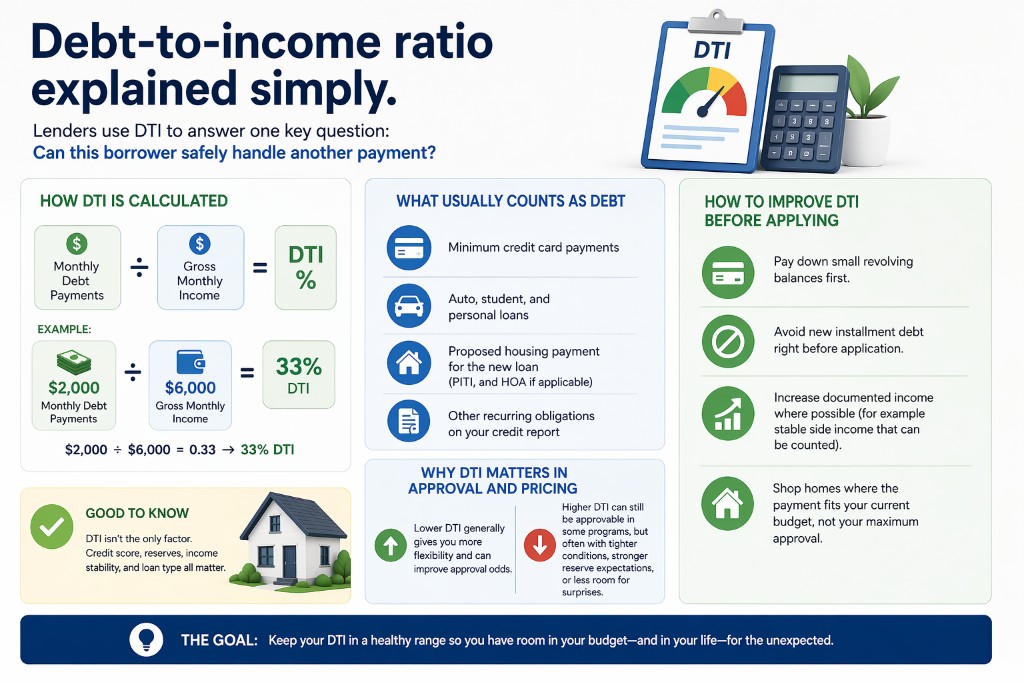
How the file is added up
Back-end DTI is monthly counted debts divided by gross monthly income. If those debts, including the new housing payment, are $2,400 and documented income is $7,200, the ratio is 33 percent. Income is almost always gross, before tax, from sources the lender can paper: W-2 wages, salary, and sometimes bonus or self-employment income with a two-year history. Cash from a side job that never hit a tax return usually counts for nothing.
The debts that go in the numerator are the ones a credit report or a court order can prove. Minimum credit-card payments, auto loans and leases, student loans, personal loans, alimony, child support, and the proposed housing payment. That housing payment is PITI, plus HOA if there is one, plus PMI when the loan requires it. A card you pay in full every month still contributes its minimum payment. Paying the balance down before you apply is one of the few fast ways to move the ratio, because only the remaining minimum counts.
What does not go in: utilities, groceries, childcare, retirement contributions, and the insurance you pay yourself unless it has already become a collection. That is the gap that makes DTI a bad household budget. Two families with the same 38 percent DTI can have completely different months if one of them is paying $1,800 for daycare. The underwriter does not see that line. You still have to live with it.
Student loans in deferment still count. Fannie Mae and most other investors use the actual payment, an income-driven plan payment, or a percentage of the balance when no payment is reporting. Zero due this month is not zero counted debt. A loan you plan to pay off comes off only if you pay it before closing and the lender has the paper. In community property states, a spouse who is not on the note can still bring debts onto the ratio. Elsewhere, joint accounts are the ones that sneak in.
Two buyers, same $8,000 of monthly gross income. Buyer A has $450 in card minimums, a $400 car payment, and a $2,550 housing payment. Total $3,400. DTI is 42.5 percent. Buyer B has $150 in card minimums, no car, and a $2,750 housing payment. Total $2,900. DTI is 36.25 percent. Buyer B can support a higher house payment and still look cleaner to an automated system. Paying off the car, in this sketch, is worth more than stretching for another $20,000 of price.
What Fannie Mae and the CFPB actually require
The 43 percent number people still quote is a leftover. Until 2021, a general qualified mortgage under the CFPB's ability-to-repay rule could not exceed a 43 percent DTI. The Bureau replaced that cap with a price-based test. A general QM now depends mainly on how far the APR sits above the average prime offer rate, usually less than 2.25 percentage points for a first-lien loan, and on the lender still considering income, debts, and DTI or residual income. The old 43 percent line is no longer the legal ceiling.
Conventional loans sold to Fannie Mae are tighter than that folklore and looser than a single number. For a manually underwritten loan, Fannie Mae's selling guide sets a 36 percent maximum, with room up to 45 percent if credit score and reserves meet the Eligibility Matrix. Desktop Underwriter casefiles can go as high as 50 percent. Cross those lines after a late change, such as a new car payment discovered before closing, and the loan can become ineligible. Freddie Mac's Loan Product Advisor uses a similar automated band.
FHA can accept higher ratios when the rest of the file is strong. VA underwriting leans on residual income, the cash left after debts, as much as on a percentage. USDA has its own grid. None of these are promises. The automated system, the property type, and the rest of the credit file still make the call. A 41 percent DTI with thin reserves and a 680 score is a different loan from a 41 percent DTI with six months of cash and a 760.
| Source | What it actually says |
|---|---|
| CFPB general QM, current rule | No 43% cap. Price-based QM. Lender must still consider DTI or residual income. |
| Fannie Mae, manual underwrite | 36% standard, up to 45% with score and reserve tests in the Eligibility Matrix. |
| Fannie Mae, Desktop Underwriter | Can accept up to 50% on a DU casefile. Above that, not eligible for delivery. |
| FHA, VA, USDA | Separate handbooks. FHA can go higher with compensating factors. VA weights residual income. |
The approval letter is the wrong budget
A lower ratio leaves more room when taxes are reassessed, insurance is repriced, or a car dies. A higher ratio can still close, especially with strong credit and reserves, and still leave a household with nothing at the end of the month. The letter says what an investor will buy. It does not say what you should spend.
The wrecks are predictable. People buy at the approval ceiling and then meet a tax bill the escrow estimate missed. They finance a car during escrow and the DTI, recalculated, no longer fits. They co-sign a relative's loan and discover the payment is on their report. They do the mental math on gross income and the shopping on take-home pay. Ask the loan officer for two scenarios: the house you want, and a payment one step lower. Keep the lower one if the higher one only works on paper.
Before you apply, pay revolving balances down rather than opening new installment debt. Document any income you want counted, early. Shop houses whose full payment, including tax and insurance, fits the month you already have, not the month the automated system invented. Pair this with PITI and escrow and the first-time buyer checklist so the ratio and the budget are not two different conversations.
Sources: CFPB on DTI, CFPB general QM final rule, Fannie Mae Selling Guide B3-6-02. Educational only.